Overview
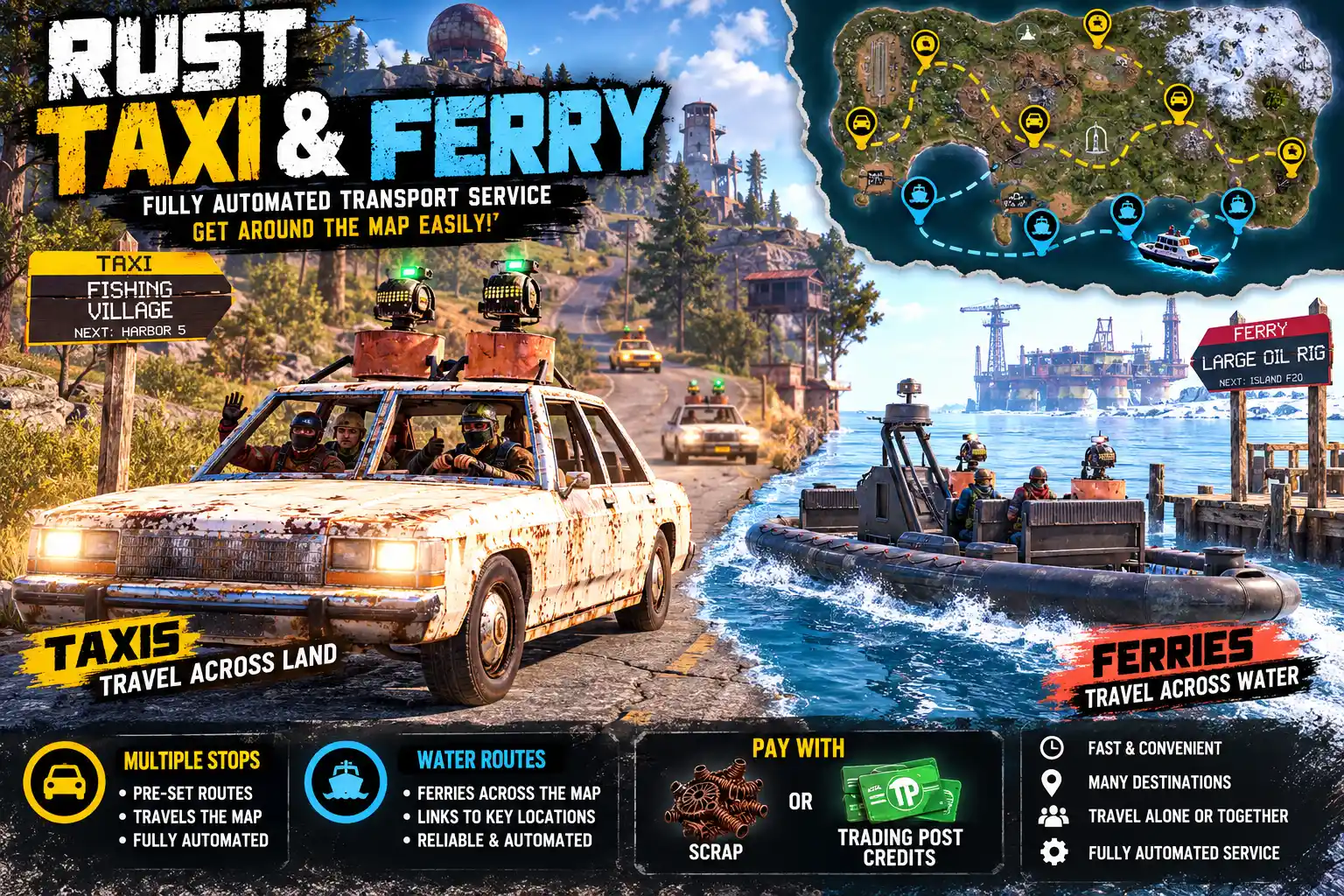
Ruber puts self-driving taxis on your map. Out of the box it links the map's own bus stops into lines, each stop named after the monument it stands by, and puts a taxi on every line. Players book a ride at a stop, pay as they get in and get out at the stop they paid for.
Islands and sea monuments are not left out either: Ruber runs ferries out to them from the mainland (see Ferries below).
Riding
- Stand at a stop and type
/ruber, or sit on its bench. The panel lists every stop on the line with its fare. - Pick one to book. If no taxi is near, one is called and drives in along the line; you can watch it come on the map.
- The taxi seats you and takes the fare as you get in, and lets you out at your stop.
Or just press E on a taxi waiting at a stop: if you have the fare to its next stop, you are seated. Stay aboard to ride on, paying for each stop as it leaves. Changed your mind? Get out before it pulls away and your fare is given back.
A taxi has no driver, so all four seats are for riders. It sounds its horn as it pulls in, drives with its headlights on at night, and toasts you when it is half a minute away, when it has pulled in and when your stop is next. Riders in their seat cannot be hurt and cannot hurt anyone, and animals, scientists, Bradley and the patrol heli leave them alone.
Stops, lines and fares
Players with the build permission claim a bus stop, or build a stop of their own beside any road (a bench, a painted sign and a lantern lit at night), and link their stops into lines. Each line sets its own fares in scrap, TradingPost credits or either (the rider picks), a fare for any ride plus a fare per kilometre, and a driving style: Driving Miss Daisy (20% cheaper), Leisurely drive or Break neck (20% dearer). The owner of the stop a ride starts from earns a share of every fare.
The driving
Taxis keep to the roads, plan their own routes, go round parked vehicles and wrecks, pull over for each other, wait at level crossings for trains, and are put back on their route if they get stuck. Where every taxi was is saved, so a restart puts each back on the same stretch.
Ferries
Out of the box every island, both oil rigs and the underwater labs get a jetty, and an RHIB ferry runs out to each from the mainland by itself, finding its own way by sea. Riding one works like riding a taxi: book at the jetty or press E on a ferry waiting at the end of the pier, and you are put off on the jetty at the other end. At the oil rigs and underwater labs the jetty is a pontoon at sea level, with ladders to climb out of the water. Ferries run with their light on at night, carry turrets and an optional radio like the taxis, and show on the map. Players with the build permission can put up jetties of their own with /ruber jetty and link them into ferry lines.
Learning from failed journeys
Ruber gets better at your map the longer it runs. When a journey goes wrong it remembers why and does something different next time. A ferry that runs aground charts the rocks and shallows it hit, and every ferry keeps clear of them from then on. A ferry that keeps failing to get away from a pier changes the way it leaves. A taxi line that keeps breaking down on the same stretch is taken out of service instead of sending taxi after taxi to fail there. What the ferries learn is saved across restarts. Admins can see what Ruber has learned about any stop from the network panel, or clear it and start over.
For admins
/ruber all opens the network panel: every line, stop, taxi and ferry, with buttons to send, recall or remove them, a RADIO tab, and a SETTINGS tab that edits every config setting in game, then saves and reloads. Optional extras include a radio in every taxi and ferry.
Turrets
Every taxi and ferry can carry two auto turrets, in one of three modes:
- Off: no turrets are fitted and the vehicles go unarmed.
- Peacekeeper (green light, the default): like the game's own peacekeeper turrets, they shoot only players who are marked hostile, so a PvE server gets no surprises.
- Active (red light, for PvP servers): they fire on every player in range except riders, their teams and anyone who has recently booked or paid on that line, and on NPCs and fierce animals too.
Nobody aboard a taxi or ferry is ever shot, and players get an on-screen warning when a taxi or ferry that would shoot them is near. Taxis and ferries are set separately, and admins can pick the turrets' gun and ammunition in SETTINGS.
Languages
English, Russian, German, French, Spanish, Brazilian Portuguese and Simplified Chinese are built in — no lang files to install.
Every download is licensed to you and watermarked with your details.
Features
- Links the map's bus stops into taxi lines by itself
- Self-driving with 4 seats or have Talkative Bert the Bandit drive leaving 3 seats
- Taxis keep to the roads and go round what is in the way
- Automatic ferries to islands, oil rigs and underwater labs
- Learns from failed journeys and avoids them next time
- Book at a stop or jump into a waiting taxi
- Fares per line in scrap or TradingPost credits
- Stop owners earn a share of every fare
- Three driving styles, each with its own fare
- Players can claim bus stops or build their own
- Stops, taxis and ferries shown on the map
- Three turret modes: Off, Peacekeeper (default, safe on PvE) or Active
- Optional radio in every taxi and ferry
- Every setting editable in game
- Seven languages built in
Install
- Download Ruber.cs from My Plugins.
- Drop it into
oxide/pluginsorcarbon/plugins. - Grant the permissions:
o.grant group default ruber.use
o.grant group default ruber.build
Leave out ruber.build if only you should put up stops. On Carbon use c.grant instead of o.grant.
The file name must stay Ruber.cs — Oxide matches it to the class name.
The config is written to oxide/config/Ruber.json (or carbon/configs/Ruber.json) on first load. Admins can change every setting in game from the SETTINGS tab of /ruber all, or edit the file and reload the plugin (o.reload Ruber or c.reload Ruber).
Fares in credits need the TradingPost plugin loaded; without it, lines take scrap.
Config
{
  "Most stops one player may own": 10,
  "Closest two stops may be to each other (metres)": 150.0,
  "Seconds a taxi waits at each stop": 30.0,
  "Fare for any ride (scrap), until a line is given its own": 5,
  "Fare per kilometre along the line (scrap), until a line is given its own": 5,
  "Fare for any ride (TradingPost credits), until a line is given its own": 10,
  "Fare per kilometre along the line (TradingPost credits), until a line is given its own": 10,
  "How a new line's fares are paid (scrap, credits or either)": "scrap",
  "Share of each fare paid to the owner of the stop the ride starts from (percent)": 20.0,
  "Turrets on taxis: Off, Peacekeeper (green, shoots only the hostile) or Active (red, shoots every player but riders and their teams, and every NPC and fierce animal)": "Peacekeeper",
  "Put a radio in every taxi, which its riders switch on and off (/ruber radio)": false,
  "Most taxis on one line": 2,
  "Link the map's bus stops into lines by itself, each named after its nearest monument": true,
  "Most stops on a line it links up by itself": 6,
  "Ferries: put up jetties by themselves linking every island and sea monument (oil rigs, underwater labs) to the mainland": true,
  "Ferries: cruising speed (km/h)": 45.0
}
Commands & Permissions
Commands
Chat
/ruber— the panel of the stop you are at, or the network panel away from one/ruber all— the network panel from anywhere/ruber stop <name>— claim the bus stop you are at, or build a stop beside the road/ruber jetty <name>— build a jetty out to deep water, for a ferry line/ruber remove— take down the stop you are at/ruber list— list your stops/ruber survey— plan the route to the next stop and report it/ruber radio [next]— switch your taxi's radio on or off, or change station
Admins
/ruber stop <name> public— a stop that belongs to nobody/ruber taxi— send a taxi along the line from the stop you are at/ruber taxi list|debug|clear|auto— list, draw, clear or bring back the taxis/ruber recall [stop]— move a line's taxis straight to their next stop/ruber roads— show how the map's roads were joined up
Console
ruber.radio— bindable, e.g.bind j ruber.radioruber.autonetwork rebuild— take down and relink the automatic stops and jetties
Permissions
ruber.use— ride taxis and ferries, and use a stop's panelruber.build— put up stops and jetties and link them into lines (can ride too)ruber.admin— edit or remove any stop, public stops, taxi commands and SETTINGS (server admins have it anyway)
Changelog
| Version | Released | Changes |
|---|---|---|
| v0.47.9 latest | Works with the Rust update of November 2026, which changed how pictures are stored. |